Extending proof theory
Developing new calculi and methods for conditional logics and their non-monotonic counterpart.
Bringing fragmented traditions in conditional reasoning together through the proof theory.
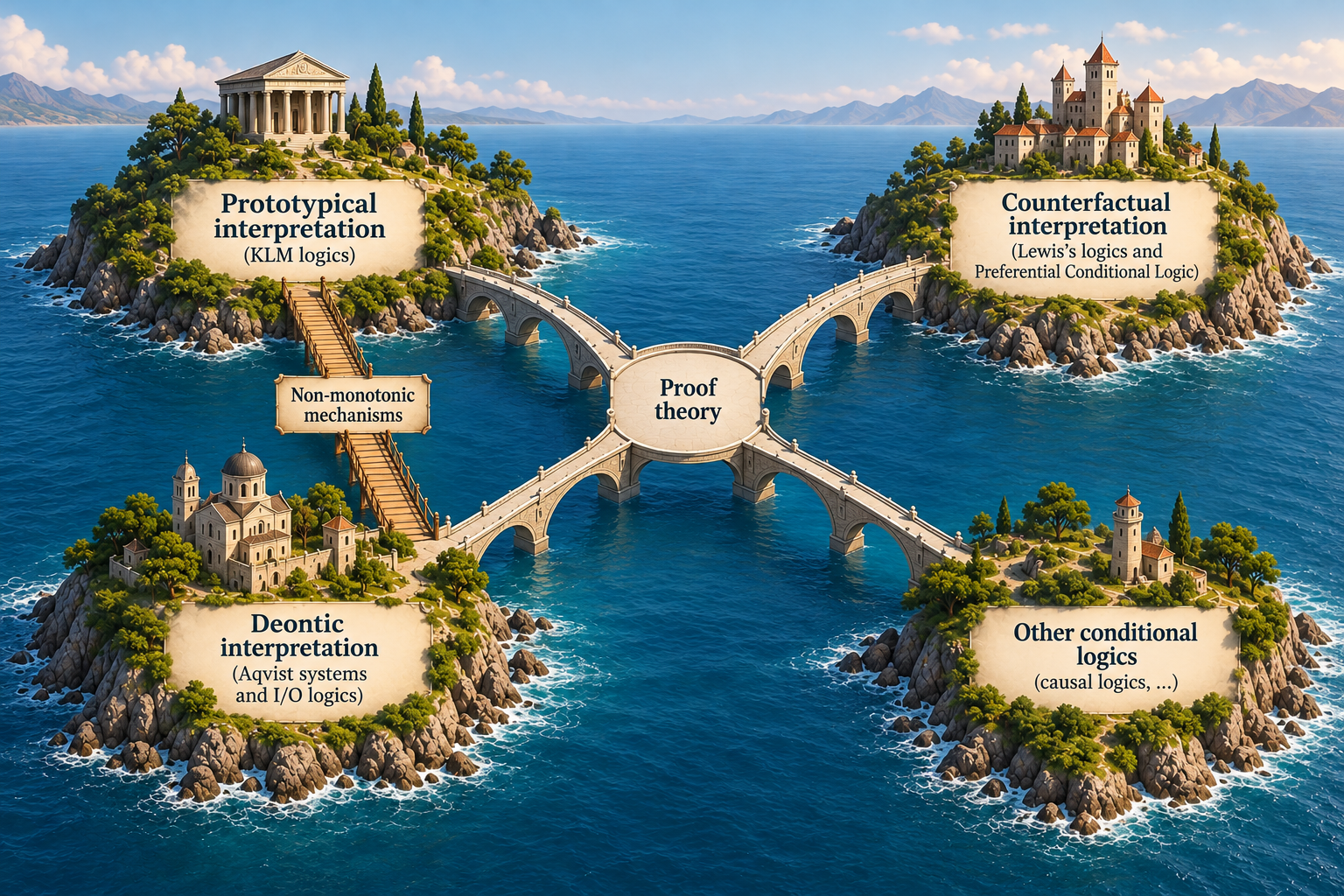
Conditional logics extend classical implication to capture various phenomena including typicality, counterfactuals, norms, preferences, and causation — forms of reasoning central to artificial intelligence, law, and decision-making.
Major frameworks addressing these phenomena, including KLM logics for typicality, Lewis-style counterfactual logics, Åqvist’s preference-based deontic logic, and input/output logics, have largely evolved in isolation. Despite their common ground, the field remains fragmented: existing methods are intricate, ad hoc, and rarely transfer even across logics within the same family.ENCORE brings these traditions together through a unified proof-theoretic lens. By developing and extending proof-theoretic methods, the project aims to clarify the relationships between logical systems, explore global forms of non-monotonic reasoning, and provide foundations for automated reasoning across the conditional landscape.
Developing new calculi and methods for conditional logics and their non-monotonic counterpart.
Investigating common proof-theoretic structures across distinct families of conditional logics.
Building foundations for proof search and efficient computational reasoning tools.
Principal Investigator (PI)
PhD student
PhD student
PhD student
Postdoctoral researcher
Dmitry Rozplokhas
Proceedings of the 27th Int. Conf. on Principles and Practice of Multi-Agent Systems (PRIMA 2026), LNCS
Dominik Pichler
Proceedings of the 27th Int. Conf. on Principles and Practice of Multi-Agent Systems (PRIMA 2026), LNCS
Dominik Pichler and Mirko Tagliaferri
Proceedings of the 21st International Symposium on Logical and Semantic Frameworks with Applications (LSFA 2026), Electronic Proceedings in Theoretical Computer Science (EPTCS), vol. 449, pp. 185–201, July 2026.
Project updates coming soon.